Asset Management and CMMS for Hotels/Hospitality
How Hotels use SuperCMMS to manage Assets and Maintenance effortlessly.
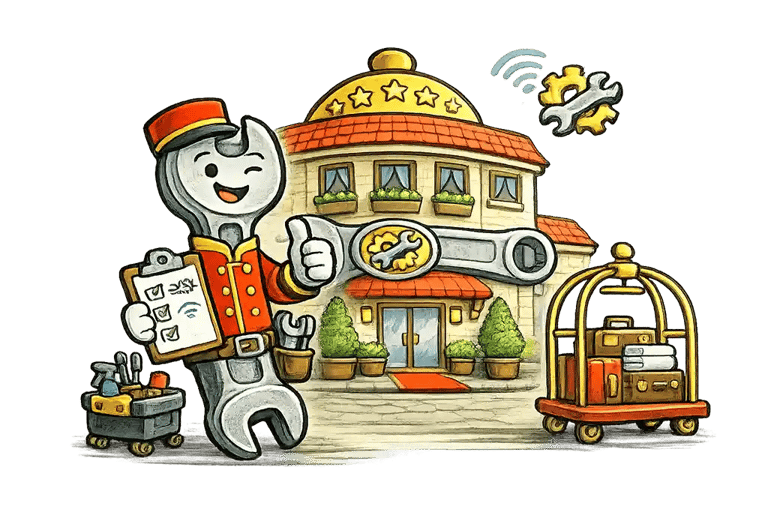
Running a Hotel means keeping dozens of assets - from elevators and HVAC systems to pool pumps and kitchen equipment - in perfect working order every single day. A missed service can mean a guest complaint, a bad review, or worse, a safety incident. SuperCMMS gives hotel maintenance teams a simple, structured system to stay on top of everything.
1. How Hotels Are Organised
1.1 The Typical Physical Structure
A hotel is built around clear physical hierarchy. At the top is the property itself - a single building or a multi-wing complex. Below that are floors, and within each floor are guest rooms, corridors, and service areas. Larger hotels may also have distinct wings, towers, or annexes that function as sub-properties within the same location.
1.2 The Key Functional Zones
Guest Floors - rooms, corridors, lifts, and shared bathrooms
Front-of-House - lobby, reception, restaurants, conference halls
Back-of-House - kitchens, laundry, housekeeping stores
Plant & Utilities - basement plant rooms, rooftop HVAC, electrical rooms
Recreational - pool, gym, spa
1.3 Who Manages What
Hotels typically have a Facility or Maintenance Manager overseeing all technical operations, supported by a team of technicians assigned to different zones. The General Manager or Operations Head reviews performance at a higher level, while individual technicians are responsible for day-to-day upkeep of equipment in their assigned areas.
1.4 Why This Structure Makes Maintenance Complex
The sheer number of assets spread across multiple zones - often on different floors with different technicians - makes it extremely difficult to track maintenance manually. A single property might have 50+ AC units, 10+ elevators, multiple generators, and hundreds of smaller parts, all needing attention on different schedules.
2. The Maintenance Problem in Hotels
2.1 Common Asset Failures and Their Costs
Hotels operate a wide range of critical assets. A faulty air conditioner in a guest room, a broken elevator, or a malfunctioning fire suppression system can disrupt operations and lead to costly repairs, refunds, and reputational damage.
2.2 Why Manual Tracking Breaks Down
Most hotel maintenance teams rely on spreadsheets, paper logs, or verbal handoffs. When staff change shifts or a technician is off duty, critical maintenance tasks fall through the cracks. There is no visibility, no accountability, and no audit trail.
2.3 What’s at Stake When Maintenance Is Missed
Missed preventive maintenance leads to reactive firefighting. Emergency repairs cost 3–5x more than scheduled ones. In hotels, downtime directly translates to unhappy guests and lost revenue.
3. Introducing the SuperCMMS 5-Level System
SuperCMMS organises every asset in your hotel using a logical 5-level hierarchy - 2 location levels and 3 asset levels. This mirrors exactly how a hotel is structured, thereby making the initial setup intuitive.
3.1 Level 1 – Location (e.g., The Grand Hotel - Main Property)
The top level represents your property or building. A hotel group can add multiple properties as separate locations.
3.2 Level 2 – Sub Location (e.g., Floor 3, Basement, Rooftop)
Break your property into zones - floors, wings, mechanical rooms, kitchens, or pool areas. This makes it easy to assign work orders to the right area.
3.3 Level 3 – Asset (e.g., Split Air Conditioner, Elevator, Pool Pump)
Each major piece of equipment is an Asset. You can track its make, model, installation date, and full maintenance history.
3.4 Level 4 – Sub Asset (e.g., Indoor Unit, Motor, Control Panel)
Complex assets can be broken into sub-components. For an elevator, the Sub Assets might be the motor, the cab, and the control panel - each with its own maintenance schedule.
3.5 Level 5 – Part (e.g., Air Filter, Belt, Lubricant)
Individual consumable or replaceable parts sit at the deepest level. Track replacement intervals and never miss a filter change or belt inspection again.
4. Setting Up SuperCMMS for Your Hotel - Step by Step
4.1 Create Your Locations
Start by adding your hotel property as a Location. Then add Sub Locations for each floor, wing, or functional zone (e.g., Guest Floors, Kitchen, Pool, Basement Plant Room).
4.2 Add Assets, Sub-Assets & Parts
Add your equipment manually or upload a CSV for bulk import. Assign each asset to its Sub Location. Then add Sub Assets and Parts where relevant.
4.3 Set Maintenance Schedules
Define how frequently each asset, sub-asset, or part needs attention. Daily, weekly, monthly, or custom intervals - SuperCMMS handles them all.
4.4 Let Work Orders Run Automatically
That’s it. Work orders are generated automatically based on the schedules you set. Your team receives them via the web app or mobile app and can update status in real time.
5. Real-World Example: Managing HVAC Across a 10-Floor Hotel
5.1 The Setup
Location: Horizon Suites Hotel
Sub Locations: Floors 1 - 10, Basement Plant Room, Rooftop
Asset: Split Air Conditioner (one per floor corridor)
Sub Asset: Indoor Unit, Outdoor Unit
Part: Air Filter, Refrigerant Valve, Fan Belt
5.2 The Schedule
Air Filter inspection 1 every 30 days
Full AC unit service - every 90 days
Refrigerant check - every 6 months
Annual deep service for each outdoor unit
5.3 The Outcome
Work orders for all 10 floors are generated automatically. The maintenance team gets their daily task list without any manual follow-up from management. Filter replacements happen on time, AC breakdowns drop significantly, and guest complaints about room temperature become rare.
6. Key Benefits for Hotels
6.1 Fewer Unexpected Breakdowns
Preventive maintenance schedules ensure equipment is serviced before it fails, reducing emergency call-outs and costly last-minute repairs.
6.2 Simplified Team Coordination via Web & Mobile
Technicians can view, update, and close work orders from their phones. Managers get a real-time view of what’s done, what’s overdue, and what’s coming up.
6.3 Complete Asset Visibility Across All Locations
Every asset from a guest room AC to a basement boiler is tracked in one place. You have a full maintenance history for every piece of equipment, which is invaluable for audits and insurance.
7. Who Is SuperCMMS For in Hotels?
7.1 Roles That Benefit
Facility / Maintenance Manager - full oversight of all scheduled and completed work
Technicians & Field Staff - clear daily task lists, no guesswork
Operations Head / GM - reports and visibility without chasing the team
Finance / Procurement - inventory tracking and planned maintenance costs
7.2 Scale It Fits
Whether you run a boutique 20-room property or a 5000-room chain with multiple locations, SuperCMMS scales with you. The free-forever plan covers small teams, and the paid plans are a fraction of the cost of any comparable Asset Management/CMMS system.
8. Getting Started Is Free
8.1 Free Forever Plan - What’s Included
SuperCMMS offers a free plan for up to 2 team members, with full access to all features - asset management, work orders, preventive maintenance schedules, and mobile access. No credit card required.
8.2 Sign Up and Be Live in Minutes
Create your hotel’s location, add your first few assets, and set a maintenance schedule - all in under 30 minutes. Your team can be up and running the same day.









Get started with SuperCMMS. It's Free.
SuperCMMS is free for 2 team members - forever and all features included. The paid version will save you a ton of money compared to ANY alternative on the market.
Give it a try. Your team, especially the field staff, will love you for it.
Trusted in 50+ Countries

99.95% Server Uptime
Forever FREE Plan




Use Cases
Vehicle Fleet / Logistics
Education
Food & Beverage (F&B)
Sports & Recreation
Construction
Building Management
Facilities Management
Public Services
Manufacturing
SuperCMMS is a free Enterprise Asset Management (CMMS) software for managing your work orders at scale.
Fits All Industries. ❤️ Made for SME's.
-----
Kepler Data Science Pte. Ltd.
68 Circular Rd.
Singapore - 049422
-----
Resources
What is a Work Order?
Work Order Software
Maintenance Management
Inventory
Warehouse Management
Preventive Maintenance
Predictive Maintenance